|
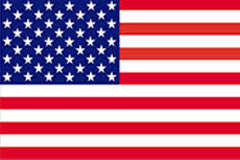
The Colors of the United States Flag
The Continental Congress left no record to show why it chose the colors.
However, in 1782, the Congress of the Confederation chose these same colors
for the Great Seal of the United States and listed their meaning as follows:
white to mean purity and innocence, red for valor and hardiness, and blue
for vigilance, perseverance, and justice. According to legend, George
Washington interpreted the elements of the flag this way: the stars were
taken from the sky, the red from the British colors, and the white stripes
signified the secession from the home country. However, there is no official
designation or meaning for the colors of the flag.
The United States Flag
The basic flag of the US is one of the world's
oldest national flags. Only the basic flags of Austria, Denmark, Great Britain,
The Netherlands, Sweden, and Switzerland are older.
During the discovery and settlement of what is now the United
States, the flags of various European nations were flown over the land, as
symbols of possession. Later, in the Colonial and Revolutionary War periods,
flags representing famous persons, places, and events were flown in the American
Colonies.
The first official flag of the United States was created by
Congress on June 14, 1777. It consisted of 13 alternate red and white stripes
and 13 white stars in a field of blue, representing the 13 colonies that had
declared their independence in 1776. Congress adopted a new flag of 15 stars and
15 stripes in 1795, to give representation to the two new states admitted into
the Union, Vermont and Kentucky.
By 1817, there were 20 states in the Union, and it became
apparent that adding one stripe for each new state would destroy the shape of
the flag. As a result, Congress in 1818 restored the original design of 13
stripes and provided that each state was to be represented by one star.
In 1912 President William H. Taft made the first official
provision for the arrangement of the stars. He ordered that there be six even
rows of eight stars each. Previously the arrangement of the stars had been left
to the flagmaker's fancy.
Many Changes in the Stars and Stripes
The evolution of the Stars and Stripes reflects the growth of
the United States. After the admission of Hawaii into the Union in 1959, the
flag was officially changed for the 26th time since its creation.
There are many government flags flown in the United States in
addition to the national flag. Among them are the president's and
vice-president' s flags and those of the federal departments and some federal
agencies. Each state in the Union has an official flag. The United States Navy
uses special flags for signaling.
FLAG TRADITIONS
Many traditions have grown up regarding the display and use of
the United States flag. These traditions, intended as marks of respect, are
widely observed. The Army, Navy, and Air Force have their own regulations, but
these do not apply outside the armed services. To supply a guide for the proper
use and display of the flag, a code was drawn up at a National Flag Conference,
held in Washington, D.C., on June 14 and 15, 1923. This was revised by the
Second National Flag Conference, held on May 15, 1924. Finally, in June 1942,
Congress adopted a resolution (amended in 1942, 1945, 1953, and 1954) that made
the flag code a law.
The Flag Code
1. The flag should be flown only from sunrise to
sunset. Upon special occasions, however, it may be displayed at night to produce
a patriotic effect. (The flag is flown day and night, in accordance with
presidential proclamation or Congressional authorization, at Fort McHenry
National Monument and Flag House Square, both in Baltimore, Md.; the Marine
Corps Monument, Arlington, Va.; and the town green in Lexington, Mass.) There
are other places where the flag is flown day and night according to local
custom. Until 1968 the United States flag flew day and night over Mount
Suribachi on Iwo Jima where it had been raised by Marines during World War II.
When the island was returned to Japanese administration, the cloth flag was
replaced by a bronze replica.
2. The flag should be displayed on all days when the
weather permits, particularly on national and state holidays and on historic and
special occasions.
3. The flag should be displayed in or near every
polling place on election days.
4. The flag should be displayed during school days in
or near every schoolhouse.
5. The flag should always be hoisted briskly and
lowered slowly and ceremoniously.
6. When carried in a procession with other flags, the
flag of the United States should be either on the marching right--that is, its
own right--or in front of the center of the line of flags.
7. When displayed with another flag against a wall from
crossed staffs, the flag of the United States should be on the right (its own
right) and its staff should be in front of the staff of the other flag.
8. When a number of flags are grouped and displayed
from staffs, the flag of the United States should be at the highest point or at
the center or the first flag at the right of the center.
9. When flags of states or cities or pennants of
societies are flown on the same halyard with the flag of the United States, the
national flag should always be at the peak. When the flags are flown from
adjacent staffs, the United States flag should be hoisted first and lowered
last. No flag or pennant should be placed above or to the right of it.
10. When flags of two or more nations are displayed,
they should fly from separate staffs of the same height and the flags should be
approximately equal in size. (International usage forbids the display of the
flag of one nation above that of another nation in time of peace.)
11. When the flag is displayed from a staff projecting
horizontally or at an angle from the windowsill, balcony, or front of a
building, the union, or field of stars, should be at the peak of the staff
unless the flag is at half-staff. When it is to be suspended over a sidewalk
from a rope extending from a house to a pole at the edge of the sidewalk, the
flag should be hoisted out, union first, from the building.
12. When the flag is displayed in a manner other than
by being flown from a staff, it should be displayed flat, whether indoors or
outdoors, or so suspended that its folds fall free as if it were staffed. When
displayed against a wall, the union should be uppermost and to the flag's own
right (observer's left). When displayed in a window, the union should be to the
left of the observer in the street.
13. When displayed over the middle of the street, as
between buildings, the flag should be suspended vertically with the union to the
north in an east-and-west street or to the east in a north-and-south street.
14. On a speaker's platform the flag, if used flat,
should be placed above and behind the speaker. It should never be used to cover
the speaker's desk or draped over the front of the platform. If flown from a
staff, it should be on the speaker's right.
15. The flag should be displayed at the unveiling of a
statue or a monument, but it should not be used as a covering. Blue, white, and
red bunting may be used as a drapery.
16. When flown at half-staff, the flag is hoisted to
the peak for an instant, then lowered to the half-staff position (half the
distance between the top and bottom of the staff). Before the flag is lowered
for the day, it is raised again to the top. For some local conditions the flag
may be flown at approximately half-staff. On Memorial Day (May 30), the flag is
displayed at half-staff until noon and at full staff from noon until sunset.
Half-staff honors the heroic dead; full staff shows that the nation lives, for
the flag is the symbol of the living nation.
Presidential proclamations set forth the following
instructions as to when and for how long the United States flag should fly at
half-staff: for 30 days from the day of death of the president or a former
president of the United States; for 10 days on the death of the vice-president,
the chief justice or a retired chief justice of the Supreme Court, or the
speaker of the House of Representatives; from the day of death until burial of
an associate justice of the Supreme Court, a member of the Cabinet, a former
vice-president, the president pro tempore of the Senate, the majority and
minority leaders of the Senate, or the majority and minority leaders of the
House; on the day of death and the next day for a senator, representative,
territorial delegate, or resident commissioner--within the District of Columbia
and until burial within the state, territory, or commonwealth concerned.
17. Flags flown from fixed staffs are placed at
half-staff to indicate mourning. Only by the order of the president may crepe
streamers be affixed to flagstaffs or spearheads in a parade.
18. When used to cover a casket, the flag should be
placed so that the union is at the head and over the left shoulder. The flag
should not be lowered into the grave or be allowed to touch the ground. The
casket should be carried foot first.
19. When displayed from a staff in a church or public
auditorium, the flag of the United States of America should hold the position of
honor at the speaker's right as he or she faces the congregation or audience.
Any other flag so displayed should be placed on the left of the speaker or to
the right of the audience.
20. When a flag is no longer fit for display, it should
be destroyed in a dignified way, preferably by burning. A flag may be washed or
dry-cleaned.
Cautions Listed in Flag Code
1. Do not permit disrespect to be shown to the flag of
the United States of America.
2. Do not dip the flag to any person or thing. The
regimental color, state flag, organization flag, or institutional flag will
render this honor.
3. Do not display the flag with the union down except
as a signal of dire distress.
4. Do not place any other flag or pennant above or to
the right of the flag. (The only exceptions are: at the United Nations
headquarters, in New York City, the United Nations flag flies above all others;
the Navy church pennant flies above the flag during church services.)
5. Do not let the flag touch anything beneath it.
6. Do not place on or above the flag, or place on any
part of it, or attach to it any object or emblem of any kind or any mark,
insignia, word, letter, figure, design, picture, or drawing.
7. Do not use the flag as drapery in any form whatever,
but always allow it to fall free.
8. Do not display or store the flag in such a way as
will permit it to be easily torn or soiled.
9. Do not drape the flag over the hood, top, sides, or
back of a vehicle, train, or boat.
10. Do not display the flag on a float in a parade
except from a staff or as follows: (a) flat or (b) so suspended that its folds
fall free.
11. Do not use the flag as a covering for a ceiling.
12. Do not carry the flag flat or horizontally but
always, as in a parade, aloft and free.
13. Do not use the flag as any portion of a costume or
athletic uniform. Do not embroider it or print it upon anything that is intended
for discard.
14. Do not use the flag in any form of advertising.
15. Do not use the flag to hold or carry anything.
The president is empowered to alter any rule or custom
pertaining to the use and display of the flag.
Proper Use of Bunting
Bunting of the national colors should be used for covering a
speaker's desk, for draping over the front of a platform, and for decoration in
general. Bunting should be arranged with the blue above, the white in the
middle, and the red below.
Click here for Bunting
Salute to the Flag
When the flag is passing in a parade or review or is being
hoisted or lowered, all persons should face the flag, stand at attention, and
salute. Those in uniform should render the military salute. Men not in uniform
should remove the hat with the right hand and hold the hat at the left shoulder,
the hand being over the heart. Men without hats and women should place the right
hand over the heart. Aliens should stand at attention. A viewer should salute
the flag in a parade at the moment it passes him.
When the national anthem is played and the flag is not
displayed, all present should stand and face toward the music. Those in uniform
should salute at the first note and retain this position until the last note.
All others should stand at attention, the men removing their hats. When the flag
is displayed, all should face it and give the appropriate salute.
Pledge to the Flag
The pledge of allegiance to the flag was first published in
1892 in Boston, Mass. Authorship was claimed for James B. Upham and Francis
Bellamy. In 1939 the United States Flag Association ruled that Bellamy was the
author of the original pledge.
In pledging allegiance to the flag, stand with the right hand
over the heart or at attention. Men remove their headdress. Persons in uniform
give the military salute. All pledge together:
I pledge allegiance to the flag of the United States
of America and to the Republic for which it stands,
one Nation under God, indivisible, with liberty and
justice for all.
STATE FLAGS
Alabama
Alaska
Arizona
Arkansas
California
Colorado
Connecticut
Delaware
Florida
Georgia
Hawaii
Idaho
Illinois
Indiana
Iowa
Kansas
Kentucky
Louisiana
Maine
Maryland
Massachusetts
Michigan
Minnesota
Mississippi
Missouri
Montana
Nebraska
Nevada
New Hampshire
New Jersey
New Mexico
New York
North Carolina
North Dakota
Ohio
Oklahoma
Oregon
Pennsylvania
Rhode Island
South Carolina
South Dakota
Tennessee
Texas
Utah
Vermont
Virginia
Washington
West Virginia
Wisconsin
Wyoming
District of Columbia*
Flags of Discovery and Settlement
Spanish. When Columbus
discovered America in 1492, he carried the banner of Castile and León. This
flag represented Ferdinand and Isabella of Spain. Other explorers who carried
the Spanish flag to America included Juan Ponce de León and Hernando de Soto.
After 1785 the historic red and yellow striped flag of Spain was flown briefly
over Florida and the Louisiana Territory.
French. Fleurs-de-lis on a
white field was one of many flags carried to America by early French explorers
and settlers. Other flags were a plain white banner and a blue flag decorated
with three gold fleurs-de-lis. A fourth French emblem, the tricolor, was
flying over the Mississippi Valley at the time of the Louisiana Purchase. This
is the present national flag of France.
English. This British Union
flag (1606-1801) was carried by the Jamestown settlers (1607) and the Pilgrims
of the Mayflower (1620). This old British Union was flown in the
American Colonies until the Revolution. Many of the early English explorers
and settlers in the New World also carried the red cross of St. George on a
white field.
Dutch. When Henry Hudson
sailed the Half Moon into New York Harbor in 1609, he flew the orange,
white, and blue flag of the Netherlands. The letters " V.O.C." were
the initials of "Vereenigde Oost-Indische Compagnie"--the United
East India Company. In 1621 the letters were changed to "G.W.C.,"
the initials of "Geoctroyeerde West-Indische Compagnie"--the Dutch
West India Company. About 1650 red replaced orange as the color of the top
stripe. The flag disappeared from the New World in 1664, when the Dutch lost
their New Netherland settlement to the English.
Swedish. The flag carried
by the Swedish colonists who settled along the Delaware River in 1638
consisted of a yellow cross on a blue field. In 1655 the flag was lowered when
the Dutch took over the settlement.
Colonial and Revolutionary Flags
During the Colonial and Revolutionary War periods a variety
of flags were flown. Few of these flags have been preserved, and there is no
official documentation concerning many of them. In painting scenes of historic
events, artists have imagined how some of the flags of the time looked. The
traditional Continental and Bunker Hill flags are examples. Knowledge of some
flags comes from descriptions by persons who claimed to have seen them. The
following historic flags have been preserved or there is official
documentation concerning them.
Andros. Created 1686. Used
as colors for military forces in New England. Edmund Andros was governor of
all New England at the time. The flag had a purple cross with a gold crown and
the monogram J R, for the Latin Jacobus Rex (King James).
New England. In use
1686-1707. It bore the red cross of St. George in the canton with the New
England pine tree in the upper left corner.
Bedford. Made as early as
1660. Minutemen from Bedford, Mass., carried this 2 1/2-foot-square
flag at the battle of Concord, April 19, 1775, but not at Lexington. An arm
and sword are thrust out from a cloud. Three round gray spots represent
cannonballs. The scroll reads "Vince aut Morire" (Conquer or Die).
Hanover Associators. First
flown 1774. This flag was adopted by volunteers of the Hanover Associators of
Hanover, Pa., June 4, 1774. The red banner emblazoned with a ready rifleman
and the charge "Liberty or Death" symbolized their defiance against
the unjust laws of Great Britain.
Taunton. First raised Oct.
21, 1774, at Taunton, Mass. The flag was the British Red Ensign of that time,
with the addition of the American watchwords "Liberty and Union."
Culpeper. In use 1775.
Culpeper County, Va., was a Revolutionary War center, and its minutemen flew
this banner. The rattlesnake device occurs on several Revolutionary War flags.
The rattlesnake's eye, brighter than any other creature's and with no eyelids,
is the symbol of vigilance. The snake never begins an attack, but once aroused
it never surrenders. The deadly bite of the rattlesnake was probably also
considered. The snake was also portrayed with 13 rattles, symbolic of the 13
American colonies.
Markoe. First used 1775.
This flag was designed by Capt. Abram Markoe for the Philadelphia Light Horse
Troop, later called the First Troop of Philadelphia City Cavalry. It is
believed to have been the first American flag to contain 13 stripes, symbolic
of the colonies. It was made of yellow silk with silver fringe. In the canton
were 13 alternate blue and silver stripes, and in the center of the flag was
an elaborate coat of arms.
Hopkins. Hoisted 1776-78.
This was the personal rank flag of the first naval commander in chief,
Commodore Esek Hopkins, and was one of the many rattlesnake flags used at this
time. Colonel Christopher Gadsden of South Carolina, taken by this flag,
presented a copy to his state legislature. Hence, it is frequently, but
incorrectly, known as the Gadsden flag.
First Navy Jack. First used
1775. This flag was used on one of the ships commanded by Commo. Esek Hopkins
during an engagement in the Bahamas in 1776. At the same time the Continental
Colors became the Navy ensign (see "Continental Colors"
below).
Washington's Cruisers. In
use 1775-76. The six cruisers of Gen. George Washington's Revolutionary War
Navy flew this flag. It was flying on the Lee when the ship captured
the English brig Nancy with its precious cargo of ammunition, Nov. 29,
1775. The Lady Washington surrendered the pine-tree emblem, when it was
captured by the Fowey, Dec. 7, 1775. An adaptation of this flag became
the Massachusetts Navy flag in April 1776.
Fort Moultrie. In use 1776.
This flag flew above Fort Moultrie (then Fort Sullivan) in Charleston Harbor
during the famous battle of June 28, 1776. Early in the attack, the flag fell
outside the parapet. Sergeant William Jasper leaped after it under a rain of
bullets, crying, "Don't let us fight without a flag." He replaced it
amid cheers. After a ten-hour attack, the British forces withdrew. The fort's
name was changed to honor the defender, Col. William Moultrie. The first
Moultrie flag (designed 1775) contained a crescent and the word Liberty on a
blue field. The original Moultrie flag was so popular that it later became the
basis for the South Carolina state flag. That flag substituted a palmetto tree
for "Liberty."
Rhode Island. In use 1776.
Colonists carried this flag at the battles of Trenton, Brandywine, and
Yorktown. It is preserved in the State House at Providence. Thirteen stars
form the crosses of St. George and St. Andrew.
Green Mountain Boys. First
used 1777. Ethan Allen and his band of Green Mountain patriots of Vermont
carried this banner in the battle that led to the capture of Fort Ticonderoga
in New York.
Eutaw. Made in 1780. This
crimson square flew at Cowpens and at the final battle of the Revolution at
Eutaw Springs in 1781. It was the battle flag of the cavalry of Col. William
Washington, George Washington's distant cousin. It was presented to him by his
fiancée, Miss Jane Elliott of South Carolina, who cut the emblem from the
back of a drawing-room chair.
Guilford. First used 1781.
The lack of specific regulations concerning the design of the American flag as
authorized by Congress in 1777 resulted in many versions. North Carolina
militiamen reportedly carried this flag at the battle of Guilford Courthouse,
March 15, 1781. It is about three times as long as it is wide. The flag has
seven blue and six red stripes. Against the white ground of the union are 13
eight-pointed stars.
Flags of the 1800s
Russian-American Company, Alaska. The
Russian-American Company in Alaska was formed in 1799. The flag flew from
trading posts until 1861, when Alaska reverted to direct rule by the Russian
government.
Oliver Perry. At the battle
of Lake Erie, Sept. 10, 1813, Oliver Hazard Perry, in command of a new fleet,
unfurled a new flag. It bore the stirring words "Don't Give Up the
Ship," spoken by Capt. James Lawrence when he was mortally wounded in the
battle between the Chesapeake and the Shannon, June 1, 1813.
Alamo. When Texas was
fighting for independence from Mexico, this flag was flown over the Alamo, the
historic mission fortress at San Antonio. On March 6, 1836, the Mexicans
captured the fortress. "Remember the Alamo" became the Texans '
rallying cry. The date on the flag refers to the Mexican constitution adopted
in 1824.
Texas Navy. President David
Burnet of Texas adopted this naval flag April 9, 1836. It was approved Dec.
10, 1836, at the first session of the Texas congress. On Dec. 10, 1836, the
Texas congress also adopted a national flag for the republic which bore a gold
star centered in a blue field. On Jan. 25, 1839, both flags were replaced by a
new emblem which later became the state flag.
California Republic. When
American settlers in California organized the California Republic June 14,
1846, they adopted this flag. The flag was replaced by the Stars and Stripes
July 9, 1846. The California state flag is an adaptation of the California
Republic flag.
Bonnie Blue. In 1861 Harry
McCarthy, an Irish comedian, sang his song `Bonnie Blue Flag' in New Orleans.
His sister carried a blue flag with a white star to honor the Texans present.
The song was enthusiastically received, and it became popular throughout the
South. The flag was used until the Confederacy adopted its own flag.
Confederate Battle Flag. During
the battle of Bull Run (Manassas), July 21, 1861, soldiers had difficulty
distinguishing between Confederate and Union flags. As a result, Southern
soldiers began carrying this battle flag. Although it was never officially
adopted, many Confederate soldiers never saw any other flag. It was officially
made with a white border on all four sides. The Confederacy used three other
flags .
Evolution of The Stars and Stripes
Continental Colors. In use
1775. On July 4, 1776, this flag became the first national flag of the United
States. John Paul Jones is believed to have hoisted this flag in 1775 as the
Navy ensign when Commo. Esek Hopkins assumed command of the new Navy . An
English spy reported that one of Commodore Hopkins' ships was flying
"English colours, but more striped." This flag was also
hoisted on Prospect Hill, near Cambridge, Mass., on Jan. 1, 1776, as the flag
of the Continental Army. The basis of the design is uncertain. Never
officially adopted, the flag was replaced by the emblem described in the
Continental Congress resolution of June 14, 1777.
Flag of June 14, 1777. This
was the first official Stars and Stripes. Although the design of the Stars and
Stripes may have been used before its adoption by Congress on June 14, 1777,
there is no official record to indicate its earlier use, as shown in some
paintings, notably Emanuel Leutze's `Washington Crossing the Delaware' of 1851
painted 75 years after the event. Congress did not direct a specific
arrangement of the 13 stars. The sponsor of this first national flag law is
unknown, though the resolution is believed to have originated in the Marine
Committee. The flag served until May 1, 1795 (see "Fort
McHenry" below).
Bennington. This flag was
probably flown at the battle of Bennington, Aug. 16, 1777, when about 1,600
Green Mountain Boys under Gen. John Stark wiped out the British forces,
contributing to the later defeat of Gen. John Burgoyne at Saratoga, N.Y.
Third Maryland Regiment. In
use 1781. At the battle of Cowpens, S.C., Jan. 17, 1781, the Third Maryland
Regiment carried this flag. It had the 13 stars and stripes as prescribed by
Congress in 1777. The Marylanders, however, chose to arrange the stars in a
circle of 12 with one in the center. This is believed to be one of the few
Stars and Stripes used by ground troops until the Mexican War.
Fort McHenry. The flag that
flew over Fort McHenry in 1814 inspired Francis Scott Key to write `The
Star-Spangled Banner'. Authorized by Congress in 1795, it was still in use
despite the fact that there were then 18 states in the Union. It remained
unchanged until 1818 (see July 4, 1818, below). Except in bad weather,
the American flag flies day and night at Key's grave, in Mount Olivet
Cemetery, Frederick, Md., and at his birthplace, Keymar, Md.
July 4, 1818. With the
adoption of this flag by a law passed April 4, 1818, the flag began to assume
its present appearance. Some favored adding a stripe for each new state, but
Congress restored the 13 stripes and ordered the addition of one star for each
new state, to take effect the 4th day of July succeeding the admission of the
state.
1859-61. At the beginning
of the Civil War the 33-star flag represented the United States. The 34-star
flag became official July 4, 1861, signifying the admission of Kansas into the
Union. Two more states (West Virginia and Nevada) were added before the war's
end bringing the total to 36 states. At no time during the Civil War was the
American flag changed to reflect the secession of states from the Union. From
1867 to 1896, 9 more states were admitted into the Union and 9 more stars were
added to the flag.
1908-12. The 46-star flag
became official July 4, 1908, reflecting Oklahoma's admission in 1907.
1912-59. When New Mexico
and Arizona were admitted into the Union in 1912, the American flag was
designed to include 48 stars. This flag represented the nation for the longest
period of time--47 years.
1959-60. The 49-star flag
reflected the admission of Alaska into the Union. It was the official United
States flag for only one year, July 4, 1959, to July 4, 1960. On Aug. 21,
1959, Hawaii became the 50th state. On this same date, an executive order
authorized the new 50-star American flag. It became official July 4, 1960.
EMBLEMS OF THE UNITED STATES
The Stars and Stripes--"Old Glory." On
June 14, 1777, Congress authorized the stars and stripes design for the
American flag. Whether Betsy Ross suggested the design approved by Congress is
not known (see Ross,
Betsy ). Thirteen stripes appeared in several
Revolutionary War flags made before the flag committee of 1777 began its work.
No one knows who suggested these stripes in the earlier flags; however, the
stripes and general design of the flag are similar to British flags then in
use.
The flag as accepted in 1777 had 13 stripes and 13 stars,
but in 1795 it was given 15 stripes and 15 stars to honor the admission of
Vermont and Kentucky to the Union. By 1817 it needed 5 more stripes and stars.
No change was made until July 4, 1818, however, when Congress restored the 13
stripes, authorized 20 stars, and ordered a star added to the flag for every
new state admitted into the Union. The name "Old Glory" is believed
to have been given the flag by Capt. William Driver, commanding the brig Charles
Doggett, in 1824.
The proper legal dimensions of the flag were prescribed by
an executive order of President William H. Taft, Oct. 29, 1912, as follows:
Hoist (height) of flag, 1 (unit). Fly (length) of flag, 1.9. Hoist of canton,
or union (blue field), 7/13. Fly
of canton, 0.76. Width of each stripe, 1/13.
Diameter of each star, 0.0616.
President. Adopted Oct. 25,
1945 (modified July 4, 1960). Before 1916 various flags represented the
president. On May 29, 1916, President Woodrow Wilson approved a design that
included the presidential coat of arms on a blue field with a white star in
each of the four corners. The flag was changed to its present design by
President Harry S. Truman's executive order of Oct. 25, 1945. The president's
personal seal appears on a blue field surrounded by a circle of stars (the
last added in 1960) representing the states. Within the circle an American
eagle turns its head toward the right (dexter) talon, which holds the olive
branch of peace. The left (sinister) talon holds the 13 arrows of war. In the
beak is a white scroll inscribed "E Pluribus Unum."
Vice-President. Adopted
Oct. 7, 1975. Proposed by Vice-President Nelson A. Rockefeller, it has a more
majestic bird, with wings uplifted, than the 1948 flag it replaced. The first
vice-president's flag, designed in 1936, was simply the president's flag with
colors reversed.
Great Seal of the United States. On
June 20, 1782, the Continental Congress adopted its seal from several designs
combined into one by Charles Thomson, secretary of Congress, and William
Barton, an adviser. In 1789 Congress authorized it as the seal of the United
States. It is used on proclamations, treaties, and commissions of officials.
Both sides of the seal appear on one-dollar bills. The eagle bears a shield
without support, signifying that the United States should rely on its own
virtues. The olive branch and arrows in the talons refer to the power of peace
and war held by Congress. The scroll "E Pluribus Unum" (One Out of
Many), the 6 red and 7 white stripes (joined by a blue chief on the shield),
and the constellation of 13 stars all represent a new nation of 13 states. The
original description of the Great Seal suggested the following color
symbolism: white--purity and innocence; red--hardiness and valor; and
blue--vigilance, perseverance, and justice. On the reverse side a pyramid
denotes strength. The motto "Novus Ordo Seclorum" (A New Order of
the Ages) and the date MDCCLXXVI (1776) stand for the Declaration of
Independence. An eye and the words "Annuit Coeptis" (He Has Favored
Our Undertaking) refer to the favor of Providence.
Click here for Military Flags
Army. Adopted 1956. The
blue design is the seal of the Army Department (and old War Department). The
date "1775" denotes the year of the Army's founding.
Secretary of the Army. Adopted
1897. This flag was designed for the secretary of war. In 1947 it was taken
over by the secretary of the Army.
Navy. Adopted 1959. In the
center of this dark blue flag is a modified portion of the seal of the Navy
Department. It is enclosed in a circle of yellow rope.
Secretary of the Navy. Adopted
1866. This flag was abolished in 1870 but it was restored in 1876. In the time
between these years the United States Jack was used.
Air Force. Adopted 1951.
This flag is based on the Air Force seal--a brown bald eagle; 13 stars for the
original colonies; and a shield with thunderbolt and lightning.
Secretary of the Air Force. Adopted
1951. The flag bears the eagle and shield of the Air Force seal in the center
and a white star in each corner.
Marine Corps. This standard
was adopted as the "regimental flag" in 1938. The flag was
redesignated as the corps standard in 1940.
Coast Guard. The present
form was adopted in 1954. This was the third change made since the ensign was
adopted in 1799. The ensign's 16 stripes represent the 16 states in 1799.
Without the badge on the seventh red stripe, this flag represents the United
States Customs Service.
United States Jack. This
was at first a flag with 13 white stars. The number of stars increased as new
stars were added to the canton of the United States flag. This small flag is
most commonly flown by government vessels when anchored. This flag may also be
flown by officers of the diplomatic corps and by governors of island
possessions, while they are on board ship. It is hoisted from the jack staff
(at the bow) from morning to evening colors. Yacht
Ensign. Introduced in 1848. It is used by private
yachts to allow them to proceed from port to port in the United States without
stopping at each customhouse. The flag was soon adopted by all pleasure craft,
but after 1968 its use was again limited to specially registered yachts. Yacht
clubs also have their distinguishing pennants, and in some cases there are
pennants for officers. Individual yacht owners usually have their own private
flags or pennants. Public Health Service.
Quarantine flag adopted 1894. The fouled anchor and caduceus (Mercury's staff)
device represents the service's original function of providing care for
merchant seamen. The same badge in white on a blue field stands for the
surgeon general of the Public Health Service. Consular
Flag. First used in 1903, it is the Diplomatic Corps
auto flag. With a large white "C" added in the circle of stars, it
is the consular boat flag, used on vessels having ambassadors or heads of
executive departments aboard.
Famous Firsts of the Stars and Stripes
The first official flag of the United States was
established by Congress on June 14, 1777. Many conflicting claims have been
made for the first displays of this flag. The following is a list of first
displays most commonly accepted for the flag established by Congress.
On a ship at sea. Nov. 1, 1777.
The Ranger, commanded by John Paul Jones, sailing from Portsmouth, N.H.
In combat at sea. November
1777. En route to Nantes, the Ranger, under John Paul Jones, captured
two brigantines and sent them into French ports as prizes.
In ground combat. Aug. 16,
1777. At the battle of Bennington (Vt.). This was the so-called Bennington
flag. The flag of the Third Maryland Regiment at the battle of Cowpens (S.C.),
Jan. 17, 1781, reflected more accurately the terms of the flag law of June 14,
1777.
Around the world. Sept. 30,
1787, to Aug. 10, 1790. Carried by the Columbia, which sailed from
Boston.
Over a schoolhouse. May
1812. At Colrain, Mass.
On the moon. July 20, 1969.
Planted in the Mare Tranquillitatis by Apollo 11 astronauts.
FIRST FOREIGN RECOGNITION
Feb. 14, 1778. A salute of
nine guns from the French fleet in answer to a salute of 13 guns given by John
Paul Jones as he entered Quiberon Bay near Brest, France.
April 24, 1778. John Paul
Jones compelled a British man-of-war to strike its flag to the American flag.
FIRST FLAG DAYS
June 14, 1861. First
observed, at Hartford, Conn.
June 14, 1893. Celebrated
in public schools for the first time, at Philadelphia.
Aug. 3, 1949. President
Truman approved a resolution designating June 14 annually as national Flag
Day.
|